This month marks the 10th anniversary of the first post on our Inspiring Learning blog!
Our first author was our colleague Celeste McLaughlin who had shared this piece with us shortly before leaving for a more senior role at the University of Edinburgh.
173 posts later, here we are!
This has been (and continues to be) our space to share advice and guidance, show our works in progress and reflect on what we’re learning about ourselves and the digital world.
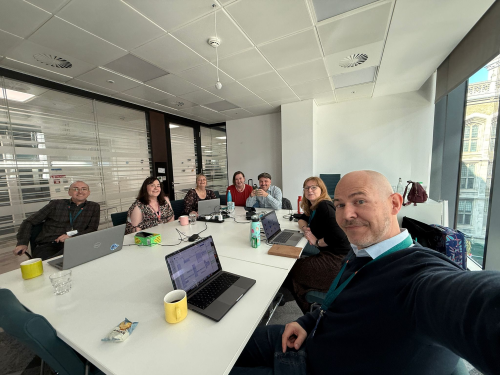
The team that writes for the blog has changed a bit over the years, saying goodbye to some Digital Practice team mates and welcoming new ones but the blog has been one of the few constants of this job since the team started in 2015. We asked the current team line up to write a short reflection on the last 10 years in Ed Tech.
So, in no particular order…
Zac Gribble

How has edtech changed for me in 10 years?
From eLearning, to TEL (technology enhance learning), to Learning Technology and even PedTech, the identity of edtech has been one that has changed with whichever is the latest buzz term.
The identity and role of Edtech has gone through big changes over the last 10 years, especially with the arrival of Covid19. Digital went from being something that was encouraged to a matter of survival for some institutions during that period.
While tools and techniques have developed over the last 10 years, the presence of EdTech may not have changed so much. There are still the trail blazers, the renegades and the pioneers. But there are also still the less confident, those unsure of its place in the curriculum or those who choose to resist, just like 10 years ago.
Kathryn Woodhead

Ten years ago, I had just finished a Media and Communications degree. I learned how to use Adobe InDesign to create infographics, books and magazines, and how to adapt my writing for different audiences. These were practical skills that took time and effort to build. Now, tools like Canva can quickly mock-up a design, and Copilot can help reshape tone and structure, which shows how much the process of creating content has changed.
My first role after university was working as a research assistant, looking at how young women discussed childbirth on social media, particularly Facebook and Twitter. At the time, these platforms felt central to everyday communication and an important space for understanding how health information was shared and interpreted. That has since shifted over time, and those platforms no longer hold the same influence.
Currently, I work with a lot of members who use immersive technologies, and we have been researching the potential accessibility benefits of smart glasses for learners. Ten years ago, as a university student who is hard of hearing, I would have welcomed live captioning through glasses during lectures. I am excited at the possibilities that these developing technologies will offer future students.
Lis Parcell

Over the 9 years I’ve been a contributor to the Inspiring Learning blog I’ve worked mainly with staff in libraries and learning resources services and their allies. A consistent thread over that time is the fact that libraries (provided they have been adequately funded and staffed) have been early adopters of digital to improve the student experience and deliver effective services, often behind the scenes.
Library services and their spaces, in HE and much of FE, have continued to evolve as a focus for digital literacy and digital support as well as centres for quality information and knowledge. Back in 2017 I was promoting the new Jisc digital capabilities framework to FE at a CoLRiC conference and today we see library services firmly embedded within the FE digital elevation tool and a digital library lens on our HE digital transformation framework.
Technologies may have changed but some themes persist: at Connect More 2019 I ran a session on ‘bringing together digital practices, learning resources and libraries’. Seven years on at #ConnectMore26 I spoke on a similar topic, only now it was online. This is a sharp reminder that while some of what we were talking about years ago has stayed relevant, organisations and staff roles change and know-how easily gets lost. We need to keep our thinking fresh and question old assumptions, but novelty isn’t everything and we shouldn’t lose sight of our past.
One way we can hold fast to our values and knowledge in difficult times is by staying close to our communities. This is why I welcome the increasing references to community activity in the Inspiring Learning blog. Our communities keep us human-centred and can help us and our members navigate the impact – both positive and negative – of digital change.
Cat Bailey

10 years seems to have passed remarkably quickly. It was great to reflect on the changes over the years but also recognise some important areas that are still going strong now.
So what’s changed?
Big changes in lecture capturing tools, policies and auto-transcription accuracy has transformed the ability to provide good quality asynchronous materials. It almost seems unbelievable now that in 2018 I would sit at the back of a lecture theatre with a camera, record the lecture, transcribe it and then manually add captions.
After the turning point of the pandemic, pushing everything online and making digital learning central almost overnight, the quality and range of online tools has improved significantly. Conference platforms, collaboration tools, and hybrid teaching setups are so much better than before.
Neurodivergent learners are being considered more and there seems to be an increase in open discussion considering the impact and advantages of digital tools and technologies on all learners has increased.
GenAI is now, of course, dominating the education sector influencing everything from assessment design to staff workflows. Hopefully, in a further ten years we’ll be able to look back in a positive light to how things have changed due to this.
What’s stayed the same?
Despite the huge shifts in how we work and the dominance of new technologies, some things seem to have stayed consistent through the years.
As seen at ALTC revisited, VLE course templates are still going strong. Accessibility has also remained a core focus since the European Accessibility Directive in 2018. While awareness has improved, it still often sits with specialists rather than being fully embedded across teams.
Copyright is another area that has only grown in importance, particularly with the shift to online and blended learning.
There are also some familiar tools and ideas that keep resurfacing. XR and 360 video have been ‘next big things’ for years, although it does feel like they are finally finding their place in the education infrastructure. And of course, where would we be without Padlet (other tools are available!) which is my consistent in a sea of tools and it doesn’t look like it will be losing its popularity anytime soon.
I wish I could time travel another 10 years and see where we’ll be with our digital practice in education. It does feel like we are at some sort of turning point in 2026 and I hope we manage to keep making changes to make useful education available to everyone.
Chris Thomson

Oddly, over the last 10 years I’ve come to empathise and identify more with people who are reluctant to engage with technology in their own practice than those who would count themselves enthusiasts! I can’t quite put my finger on why that should be.
About 10 years ago I stopped describing myself as an advocate for technology. Tech seemed to be doing well enough without my help! What I became more interested in was becoming an advocate for people working with technology and the challenges they faced.
It’s been interesting watching over the last decade the role technology has played in relation to power and money, some of which has had a beneficial social impact, but some that definitely hasn’t.
Nowadays, I find myself reading more about reclaiming digital sovereignty and digital degrowth, looking for opportunities for technology to help us be more human, more empathetic, more creative.
I’m actually quite hopeful for the next 10 years. I would like to see a re-balancing of power towards people and more accountable institutions and I think we’re seeing the slow beginnings of that, in Europe at least. But that’s not something that will happen organically; it has to be demanded and worked for.
Catherine Evans

10 years ago, I was working in an FE college, supporting teachers in their pedagogical practice alongside my own teaching. Interactive White Boards were in most classrooms and staff were encouraged to use the built-in interactive games and tools. Kahoot was still relatively new and “Inspire” CPD sessions focused on how to use quizzing tools effectively for formative assessment.
However, it quickly became clear where one learner interacted at the board while others watched, left many as passive observers. The shift towards more inclusive, active participation highlighted the need for every learner to have access to a digital device.
Fast forward10 years, and that transformation is now firmly embedded in practice. Learners routinely engage with interactive activities on their own devices, participate in hybrid or remote sessions, and experience digital tools as an integral part of everyday learning.
For educators, the landscape has evolved just as dramatically. Tasks that once took hours, such as creating quizzes, lesson plans, or learning resources, can now be completed in minutes, with generative AI embedded within many platforms. This has not only increased efficiency but also opened up new possibilities for creativity, differentiation, and responsiveness in teaching.
Personally, I still use many of my long-standing favourites, PowerPoint, Mentimeter, and Padlet, but these tools have evolved alongside practice. Each now incorporates AI-powered features that enhance interactivity, streamline design, and support learner engagement in new ways.
Accessibility is another area where the shift has been profound. While it was already on the agenda a decade ago, it often required additional time and expertise. Today, built-in accessibility checkers and design guidance are standard features, making inclusive practice a seamless part of creating digital resources rather than an afterthought.
Looking back, the past decade has not just been about new tools, but about a fundamental shift in how we think about participation, accessibility, and the role of technology in learning. The challenge for the next ten years will be not simply to adopt new innovations, but to continue using them in thoughtful, evidence-informed ways that genuinely enhance the learner experience.
Scott Hibberson

Over the past decade, digital practice within Jisc has evolved considerably, and we have seen many good people come and go.
One constant throughout this time, though, has been our openness and willingness to work alongside others in Jisc, as well as our members, to achieve shared goals. In the early days that often meant working with our R&D department (remember ‘Jisc Futures’?) on the burgeoning digital capability service. As much of this foundational work matured, cross-departmental working became more deliberate and strategic. The digital capability framework needed contextualising for individuals and organisations, which often meant aligning practice with leadership. This ensured staff came with us on that journey through the many workshops, webinars and interventions we did at that time.
The pandemic marked a big shift in how people worked together. When learning suddenly moved online in early 2020, different teams had to work much more closely than before, often breaking down usual boundaries between departments. This also highlighted the value of the work Jisc had already been doing. Teaching staff, digital teams, student services and libraries worked side by side to keep learning going, make it accessible and support students during a difficult time.
However, this collective response highlighted both the strengths and gaps within institutional collaboration, reinforcing the importance of shared ownership in digital delivery. In the years that followed, hybrid learning models gained in popularity, demanding ongoing partnership between physical and digital campus functions and encouraging institutions to redesign learning experiences that could flex. I was lucky enough to work with many great people at this time to help develop aspects of the Digital Teaching Professional Framework with the Education Training Foundation.
Digital wellbeing emerged as a critical theme, particularly from 2021 onwards, reflecting the human impact of increasingly digital environments. As hybrid learning became more normalised, Jisc’s work highlighted the need to balance flexibility with boundaries, addressing staff workload, digital fatigue and student mental health.
Collaboration again proved essential here, with wellbeing no longer confined to support services but integrated into curriculum design, digital policy and leadership decisions. More recent discussions around AI have further complicated this landscape, raising questions about cognitive load, ethical use and the emotional dimensions of interacting with chatbots, reinforcing the need for a joined-up, human-centred approach.
More recently, digital sustainability has also become a defining concern. Staff and students ultimately have to balance rapid innovation with tech, especially with the rise of AI, alongside resource use that is sustainable and takes into account both staff concerns and student experience.
Taken together, the last ten years show a clear shift: from building digital skills to creating strong, collaborative and sustainable ways of working that support wellbeing and shared responsibility.
