Image by Ghasoub Alaeddin from Pixabay
Reflection is often where learning becomes meaningful. Whether we’re reviewing a project, evaluating a teaching intervention or planning our next steps, taking time to make sense of experience helps turn activity into learning.
So what happens when reflection becomes a conversation rather than a written exercise?
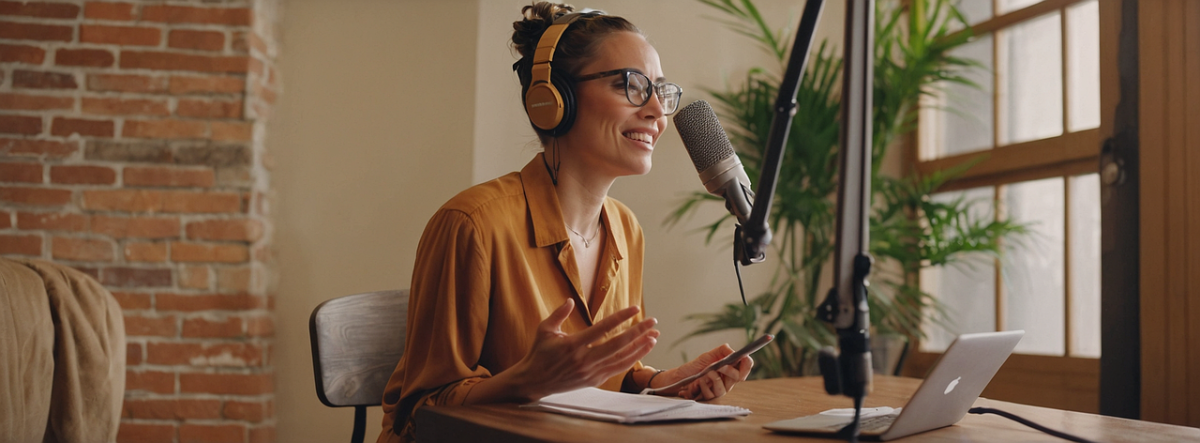
That was the question we explored during a recent workshop for the Jisc Adobe Transforming Together programme, where we invited participants to create short podcasts reflecting on their experiences of embedding Adobe Express within their institutions.
Can podcast creation be a useful reflection tool?
I wanted to develop a workshop that encouraged participants to reflect on their year embedding Adobe Express and decide on their next steps for the following year. As community and peer-learning are founding ideas of the programme, it felt important that participants could reflect usefully with their fellow participants.
My initial thoughts were that podcasting would be a means to encourage authentic and informal reflections and observations. In previous sessions, participants were keen to learn and share with each other and this felt like a useful medium to be able to do this.
This felt particularly important because reflection often consolidates learning. As educational philosopher John Dewey suggested, we learn not just from what happens to us, but from making sense of those experiences and considering future action.
More recent work on reflective practice has continued this theme, emphasising the importance of examining experience, questioning assumptions and identifying future action. With this in mind, I wanted to explore whether creating a podcast could provide a useful structure for that process.
Reducing the technical barriers
One challenge with podcasting activities is that they can appear technically demanding. Recording equipment, editing software and audio quality concerns may discourage educators from considering audio-based reflection activities.
However, browser-based tools have reduced many of these barriers. Having previously experimented with Adobe Podcast alongside my colleague, Cathie Evans, I felt it offered a practical way to test the approach without requiring specialist equipment or advanced technical skills. This is not a plug for Adobe Podcast and other tools are definitely available but since this was an Adobe-focused programme, this seemed a sensible approach. The idea was that if it were successful, participants could also take it back to their institutions as a suggested tool to create more authentic learning experiences for students.
In practice, three features proved particularly useful:
- Automatic audio enhancement
- Transcript-based editing
- Royalty-free music for introductions and endings
What did we learn?
The session was great fun. Participants welcomed the opportunity to discuss their experiences with people from other institutions. One said they could have gone on discussing their thoughts for another couple of hours.
Several themes emerged:
- Participants valued structured time for reflection.
- The conversational format encouraged honest discussion.
- Hearing experiences from peers helped participants contextualise their own work.
- The technology created relatively few barriers to participation.
Participants also identified potential applications within their own institutions, particularly for reflective activities, project reviews and collaborative assessment tasks. There would need to be good scaffolding in place and clear guidance around:
- What makes a good podcast
- How to create the podcast
- How to edit the podcast
By removing the technical burden of equipment and tool proficiency, it opens up this form of reflecting to a much wider audience. Adobe Podcast also allows for users to join from different locations, so podcast contributors don’t even need to be in the same room as each other.
What would I change next time?
The biggest limitation was time. Whilst participants created and discussed their podcasts, we had little opportunity to reflect on the process itself.
This raises an important question: was the value derived from podcasting specifically or from simply providing dedicated time and structure for peer reflection?
At this stage, I can’t confidently answer that question.
Future iterations could compare podcasting with other reflective approaches, such as written reflection or facilitated discussion, to explore whether the medium itself influences the depth or quality of reflection.
I would also like to investigate whether creating a podcast helps participants identify different insights, actions or connections than they might through more traditional reflective activities. It also raises the idea of the Hawthorne Effect, as discussed in our recent post on Smart Glasses; that people act inauthentically when someone records them.
How can you transfer this to you own practice?
Based on this initial experience, podcasting may be worth considering when:
- Reflection and dialogue are learning objectives.
- Peer learning is important.
- Learners may be less comfortable with formal written reflection.
- Communication skills are part of the intended outcomes.
However, successful implementation is likely to depend on appropriate scaffolding. Participants will need guidance on:
- Effective reflective practice
- Podcast planning and structure
- Recording and editing
- Accessibility considerations, including transcripts
Tell us about your experiences
Have you used podcasting as a reflective tool yourself? Are staff using this as a teaching or assessment activity at your organisation? Do you have any tips or tricks you can share?
Please do let us know either in the comments section of this blog or by email to cat.bailey@jisc.ac.uk.
Find out more about the Jisc Adobe Transforming Together programme..
With thanks to Rosie Hare, Glyn Rogers and others who kindly shared their podcasting experiences and resources with me prior to this session and the Transforming Together participants who were so willing to get involved.