Online collaboration has become a defining feature of contemporary academic and professional work. Yet despite widespread familiarity with digital tools, many teams continue to struggle with engagement, inclusion, and effectiveness in virtual environments. This blog post argues that Tuckman’s model of team development provides a useful conceptual framework for understanding and improving online collaboration practices.
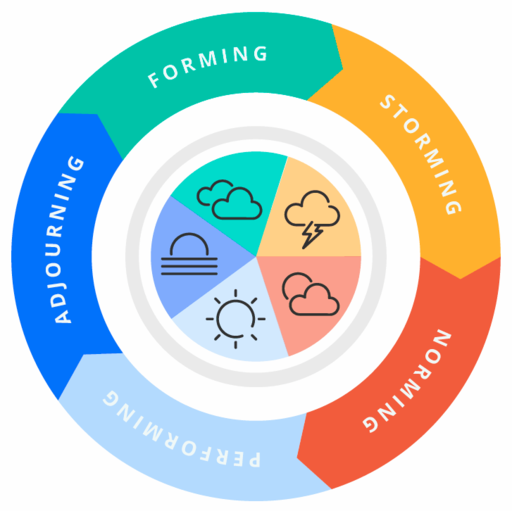
Originally proposed in 1965 and later expanded, Tuckman’s model describes how teams typically evolve through five stages: forming, storming, norming, performing, and adjourning. When applied thoughtfully, it can help leaders and facilitators design online interactions that support teams at each stage of development.
Why Tuckman still matters for online teams
Tuckman’s model helps leaders make sense of common team behaviours and challenges, reminding us that effective collaboration takes time. Trust, psychological safety, and mutual understanding do not emerge instantly, particularly in online or hybrid settings where informal social cues are reduced.
In organisations where project-based and cross-functional teams are common, teams are not always given sufficient time to progress naturally through these stages. As a result, teams may remain stuck in early phases, never fully reaching the high-trust, high-performance state associated with the performing stage.
Using Tuckman’s model as a lens allows us to ask a critical question: What practical steps can we take, at each stage, to improve online collaboration?
Forming: Designing for inclusion from the start
The forming stage is characterised by politeness, uncertainty, and a lack of clarity around roles and expectations. In online environments, these challenges are amplified by unfamiliar platforms, accessibility barriers, and uneven participation.
Inclusivity in online collaboration is not accidental; it must be designed in advance. Leaders and facilitators should consider questions such as:
- Do participants have any access requirements?
- Are there barriers to participation we can remove?
- How will people know how and when to contribute?
Practical strategies include:
- Building in explicit check-in points
- Asking open and inclusive questions
- Scheduling regular breaks
- Providing content in alternative formats
- Sharing accessible materials (agendas, slides, discussion prompts) well in advance
Accessibility guidance, such as Jisc’s Digital Accessibility Foundations module, highlights the importance of predictable structure, accessible formats, and clear communication. Small actions, such as sharing instructions for enabling captions or transcripts, or ensuring links shared in chat are accessible, can significantly reduce cognitive load and anxiety for participants.
Inclusivity at the forming stage sets the tone for everything that follows.
Storming: Navigating tension and difference
The storming stage is where differences surface. Conflicting perspectives, working styles, and expectations can create tension, particularly online where miscommunication is more likely.
Rather than viewing storming as a failure, Tuckman frames it as a necessary and potentially productive phase. Exposure to new perspectives can challenge assumptions and lead to innovation, but only if communication is well managed.
Consistency and predictability are important here, especially:
- Clear, structured agendas
- Regular meeting times
- Advance notice of changes
- Explicit explanations of purpose
- Avoidance of last-minute or impromptu meetings
One common source of frustration in online settings is the feeling of being ignored. When contributions go unacknowledged, particularly in chat-based discussions, participants may disengage. Simple practices such as thanking people for their input, even when ideas are not adopted, reinforce psychological safety. Feeling heard often matters more than being right.
Offering multiple modes of participation – spoken, written, synchronous, asynchronous, also helps mitigate tension. Different people contribute best in different ways, and valuing reflective as well as vocal participation is essential for equitable collaboration.
Norming: Establishing shared practices and expectations
Viewed through Tuckman’s model of team development, breakout rooms are most effective from the norming stage onwards, when trust, roles, and shared expectations are established. At this stage, smaller groups encourage more open conversation, higher engagement, and more focused discussions where participants have greater agency. Breakout rooms also support parallel working, allowing teams to tackle multiple issues at once, while strengthening rapport and peer learning, key features of norming and performing teams.
Earlier in the process, however, breakout rooms can magnify challenges such as technical barriers, drop-outs, anxiety about speaking with strangers, and discussions being dominated by a few voices. Without clear purpose and structure, these issues can limit outcomes, reinforcing the case for using breakout rooms once teams have moved beyond the forming and storming stages.
The use of webcams in online collaboration is a particularly contested issue. Cameras can enhance connection and communication in some contexts, such as small group discussions or one-to-one meetings. In other contexts, such as large meetings or sessions where participants are in listening rather than doing mode, they may cause distractions or detract from the experience.
Rather than adopting blanket rules, effective teams use cameras with purpose and intentionality. Environmental considerations also matter: research suggests that turning off cameras can significantly reduce carbon emissions compared to video streaming. As with other digitally mediated practices, awareness of impact should inform decision-making.
Norming is about agreeing on what works for this team, in this context, and remaining open to revisiting those agreements as needs change.
Performing: Sustaining high-quality online collaboration
The performing stage represents the aspiration for most teams: efficient collaboration, high trust, and shared confidence. Teams at this stage tend to have a strong understanding of one another’s strengths and communication preferences.
However, not all teams reach this stage, particularly in hybrid settings where some members are co-located and others remote. Without careful facilitation, remote participants can feel marginalised.
Emerging good practice includes assigning an “advocate” for remote participants – someone responsible for ensuring their contributions are heard and their needs considered. Deliberately building in pauses, rather than rushing to fill silences, also supports deeper thinking and reduces pressure in online discussions.
Cognitive overload is a real and persistent challenge in digital environments. Normalising silence, reflection, and processing time can significantly improve the quality of collaboration.
Adjourning: Reflection, learning, and closure
Tuckman’s later addition of adjourning reminds us that endings matter. When teams disband, there is value in reflection: What worked well? What could be improved? What should we carry forward?
Creating space for collective reflection helps consolidate learning and provides closure, even when team membership changes. It also reinforces the idea that effective collaboration is built through habits, not one-off interventions.
Conclusion
Online collaboration is complex, effortful, and deeply human. Tuckman’s model offers a valuable framework for understanding that complexity and for designing intentional, inclusive practices at every stage of team development.
By paying attention to forming, supporting teams through storming, agreeing norms thoughtfully, sustaining performance, and reflecting at the end, leaders can significantly improve the quality and humanity of online collaboration.
The challenge, and the opportunity, lies in turning these insights into everyday practice.

